Critical Considerations When Choosing an Agentic AI Clinical Operations & EDC Platform
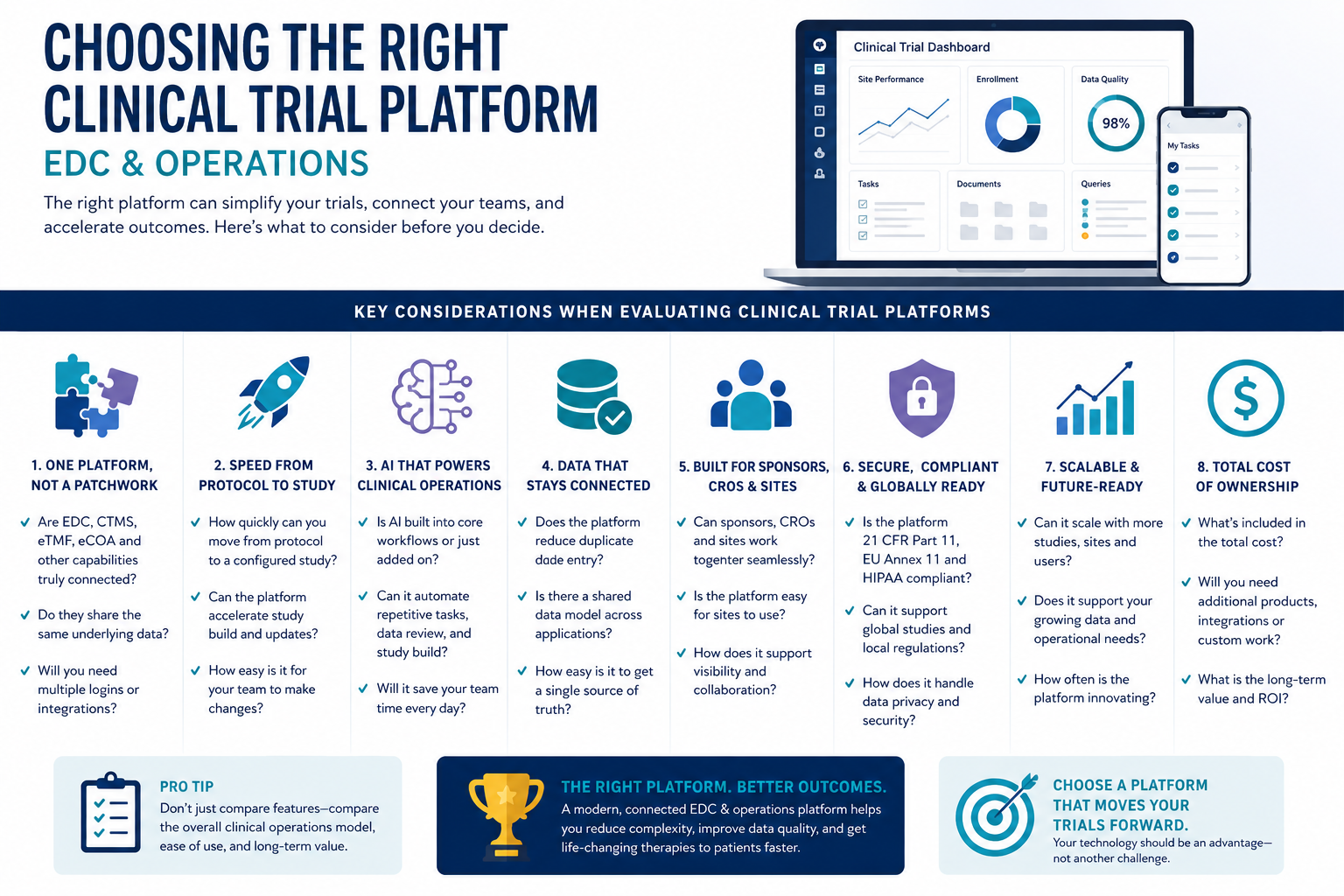
Table of Contents
- What Sponsors, CROs, and Research Sites Should Consider Before Selecting Clinical Trial Technology
- 1. Is It Really One Platform?
- Consider an All-In-One Platform
- 2. How Quickly Can You Go From Protocol to Study?
- What to look for:
- 3. Is AI Actually Integrated Into Clinical Operations?
- 4. Does the Platform Reduce Duplicate Data Entry?
- What to Look For:
- 5. How Many Vendors Will You Actually Need?
- 6. Can Sponsors, CROs, and Sites Actually Work Together?
- 7. How Easy Is the Platform for Sites to Use?
- 8. Can the Platform Scale With You?
- Download Our Buyer's Guide eBook:
- eBook: Critical Considerations When Comparing AI-Clinical Trial & EDC Platforms
- Why Clincove?
- Before You Choose Your Next EDC or Clinical Operations Platform, Compare It With Clincove.
What Sponsors, CROs, and Research Sites Should Consider Before Selecting Clinical Trial Technology
Choosing a clinical operations or Electronic Data Capture (EDC) platform is one of the most important technology decisions a clinical trial organization can make.
The right platform can help simplify study setup, connect teams and data, reduce manual work, and improve study execution. The wrong technology stack can leave teams managing multiple vendors, disconnected systems, duplicate data entry, integrations, and increasingly complex workflows.
And not every clinical trial platform is built the same.
Before selecting your next clinical operations platform, look beyond the feature checklist. Here are the critical areas sponsors, CROs, and research sites should compare.
1. Is It Really One Platform?
Many vendors offer a "clinical suite," but that doesn't necessarily mean every product operates as one connected platform.
Before buying, ask:
- Are EDC, CTMS, eTMF, eISF, eCOA, and other capabilities truly connected?
- Do they share the same underlying data?
- Will your team need separate logins or applications?
- Are additional integrations required?
- Will information need to be entered multiple times?
- Are certain capabilities actually separate products or acquisitions bundled together?
- How much additional configuration is required to make everything work together?
Consider an All-In-One Platform
An all-in-one clinical operations platform, brings critical study functions into a connected environment.
Rather than stitching together multiple point solutions, teams can manage:
- EDC
- CTMS
- eTMF
- eISF
- eCOA
- Source records
- Telehealth
- Tasks and workflows
- Study data and reporting
One platform. One connected clinical operations environment.
2. How Quickly Can You Go From Protocol to Study?
Having more features doesn't necessarily make a platform better.
A critical question is:
How quickly can those features actually get your study operational?
Consider:
- How long does initial study configuration take?
- How much manual configuration is required?
- How quickly can CRFs be created?
- Can protocol information automatically drive downstream workflows?
- How dependent are you on professional services?
- How difficult are mid-study changes?
- Can your internal team make changes themselves?
What to look for:
Take a protocol-to-platform approach, using AI-assisted workflows to help accelerate the journey from:
Protocol → Study Design → CRFs → Configuration → Execution
The goal is to reduce repetitive configuration and get studies operational faster.
3. Is AI Actually Integrated Into Clinical Operations?
Almost every technology company now talks about AI.
The better question is:
What does the AI actually do?
Look beyond an AI chatbot or isolated feature and evaluate whether AI can meaningfully improve everyday clinical operations.
Ask whether the platform can help:
- Interpret protocol information
- Generate study components
- Create CRFs
- Automate repetitive workflows
- Reduce manual data entry
- Support source-to-EDC workflows
- Organize study information
- Identify operational issues
- Reduce administrative workload
4. Does the Platform Reduce Duplicate Data Entry?
This should be one of the most important questions in any clinical technology evaluation.
If the same information has to be entered into multiple systems, your technology stack isn't really integrated.
Ask:
- How many times will the same data be entered?
- Does information automatically flow between applications?
- Are integrations required to synchronize data?
- What happens when information changes?
- How much reconciliation will teams need to perform?
- Which system becomes the source of truth?
What to Look For:
A shared data model, allows information to support multiple workflows without unnecessarily recreating it across disconnected systems.
That can mean:
- Less duplicate entry
- Less reconciliation
- Fewer unnecessary data transfers
- Greater consistency
- Better operational visibility
- More connected workflows
Enter data once. Use it throughout the study.
5. How Many Vendors Will You Actually Need?
A lower-priced EDC platform isn't necessarily less expensive if you still need to purchase several other systems.
Your true technology cost may include:
- EDC
- CTMS
- eTMF
- eISF
- eCOA
- Site technology
- Patient engagement tools
- Integrations
- Implementation
- Professional services
- Data migration
- Training
- Support
Before comparing prices, compare the total technology stack required to operate the study.
The comparison shouldn't simply be:
EDC Price vs. EDC Price
It should be:
Total Clinical Technology Stack vs. Total Clinical Technology Stack.
6. Can Sponsors, CROs, and Sites Actually Work Together?
Clinical trials don't operate in organizational silos.
Sponsors, CROs, research sites, investigators, and other stakeholders need to collaborate throughout the study.
Evaluate:
- Sponsor visibility
- CRO workflows
- Site usability
- Document exchange
- Task management
- Data access
- Study communication
- Patient workflows
- Cross-organizational collaboration
7. How Easy Is the Platform for Sites to Use?
A platform can have hundreds of capabilities and still fail if research sites don't want to use it.
During evaluation, don't just ask what administrators can do.
Ask what the site experience looks like.
Consider:
- Number of logins
- Ease of training
- User interface
- Duplicate data entry
- Document workflows
- Source-to-EDC processes
- Task management
- Time required for routine activities
Every unnecessary click or duplicate workflow becomes additional work when multiplied across hundreds or thousands of study activities.
8. Can the Platform Scale With You?
Don't buy clinical technology based only on what you need today.
Consider what happens when you add:
- More studies
- More sites
- More countries
- More users
- Larger datasets
- More complex protocols
- Additional sponsors or CRO partners
- New workflows
Ask whether growth requires buying additional products or rebuilding your technology stack.
Clinical Operations Platform Comparison Checklist
When evaluating Clincove or any other clinical trial technology provider, use these questions:
- ✅ Does it provide EDC?
- ✅ Does it include CTMS?
- ✅ Does it support eTMF and eISF?
- ✅ Does it support eCOA?
- ✅ Does it support source records and site workflows?
- ✅ Do the applications share data?
- ✅ Can it reduce duplicate data entry?
- ✅ Does it reduce the need for third-party integrations?
- ✅ Can AI automate meaningful clinical workflows?
- ✅ Can it accelerate protocol-to-study configuration?
- ✅ Is it easy for research sites to use?
- ✅ Can sponsors, CROs, and sites collaborate?
- ✅ Can your team configure and modify studies efficiently?
- ✅ Does it scale across multiple studies and sites?
- ✅ What is the total cost after implementation, integrations, support, and additional products?
Don't Compare Features. Compare the Entire Clinical Operations Model.
Choosing a clinical operations platform shouldn't come down to which vendor has the longest feature list.
The more important question is:
Which platform can help your organization run clinical trials more efficiently?
Compare how platforms handle:
Study Setup → Data Capture → Site Operations → Trial Management → Documents → Patient Data → Collaboration → Reporting
Then evaluate the technology underneath it all:
Data → Integrations → AI → Automation → Usability → Cost → Scalability
That's where the differences between clinical operations platforms become much clearer.
Download Our Buyer's Guide eBook:
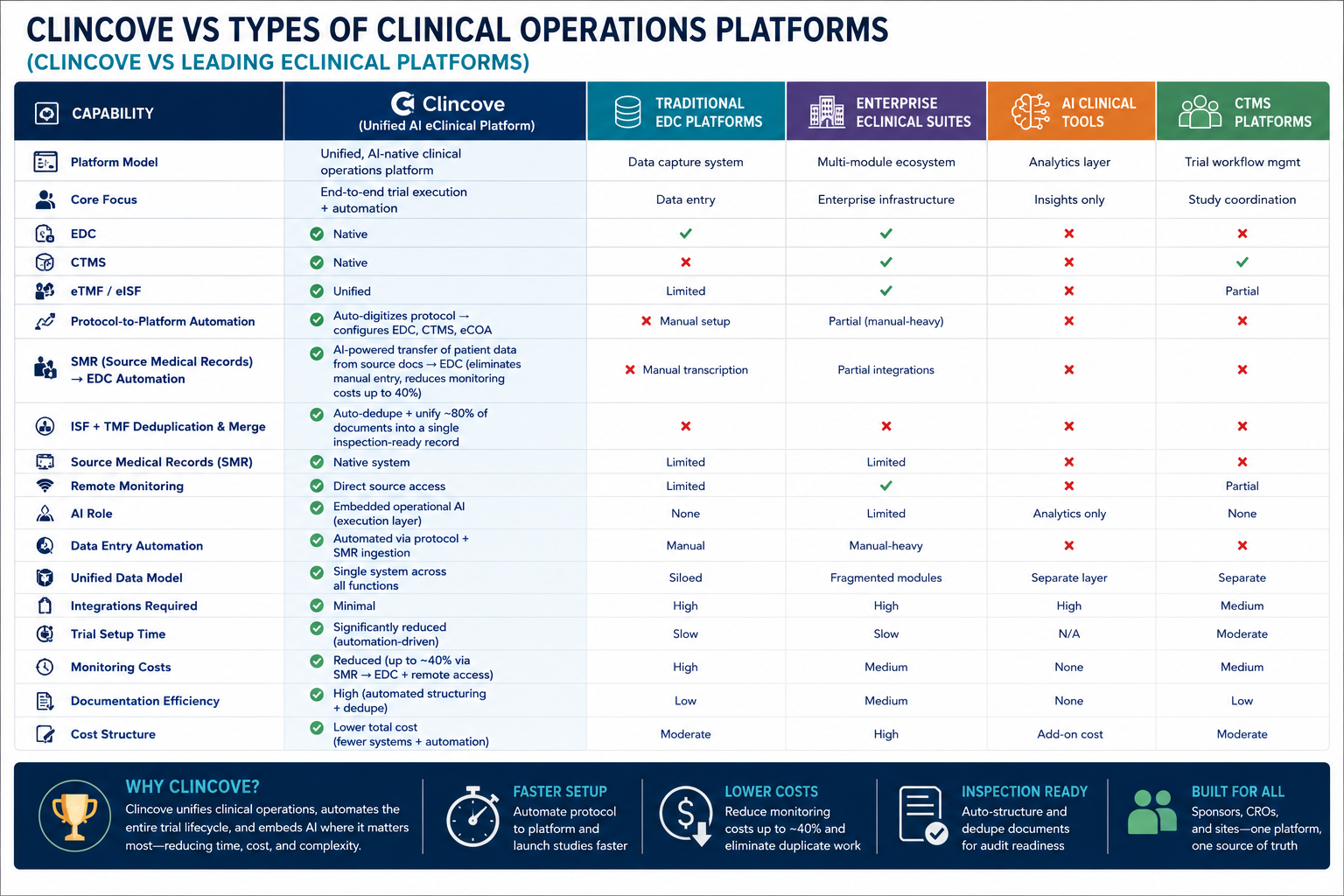
Why Clincove?
Clincove brings together clinical operations, data capture, study management, site workflows, and AI-powered automation in one connected platform.
Instead of asking your clinical teams to adapt to a growing collection of disconnected systems, Clincove is building technology around how modern clinical trials should operate.
Fewer systems. Less manual work. More connected data. Faster clinical operations.
Before You Choose Your Next EDC or Clinical Operations Platform, Compare It With Clincove.
Continue Reading

How AI Can Help CROs Create More Capacity Without Replacing Clinical Expertise
How can technology give experienced clinical teams more capacity to do the work that matters most?

Grow Together: Introducing the Clincove Partnership Program - for CROs, SMOs and Sites

Clinical Trial Operations Planning: The 2026 Checklist Every Sponsor Should Download (Clinical Trials Planning Template Included)
Improve study planning with a free clinical trial operations template covering budgets, milestones, vendors, risks, comp
Simplify clinical operations
Ready to modernize your clinical trials?
See how Clincove unifies EDC, eISF, eTMF, and eSource into one platform -- deploy in weeks, not months.